AI energy management in manufacturing: Ford Otosan's MEGA AI APEM example
At its Gölcük and Yeniköy plants in Kocaeli, Ford Otosan monitors energy at 1,000+ points with MEGA AI APEM and triggers automatic work orders. What AI energy management in manufacturing means for factories.
Factory digitalization is often told through MES, quality or robotics. The energy layer still ends up as a monthly report. Ford Otosan's MEGA AI APEM (AI-supported energy management), which the company said it put into service in 2026 at its Kocaeli plants, ties monitoring to shop-floor action [1]. This article reviews AI energy management in manufacturing, links it to MES/ISA-95 discussions, and closes with a checklist other producers can use.
What MEGA AI APEM does
According to Ford Otosan's statement carried by Ekonomigazetesi, the system runs at the Gölcük and Yeniköy plants. It monitors electricity, natural gas, water and compressed air at more than 1,000 points, spots deviations from expected consumption in real time, and mobilizes field teams with automatic work orders [1]. Energy management moves from lagging reports to a closed loop of monitoring plus action.
The Kocaeli plants' combined capacity is stated as 612,000 vehicles per year [1]. APEM is described not as an off-the-shelf package but as an industrial AI layer co-developed by Ford Otosan's production, energy, maintenance and data teams [1].
Stated targets and a concrete incident
| Indicator | Figure in the company statement |
|---|---|
| Annual CO₂ reduction target | 2,560 tonnes [1] |
| Energy saving per vehicle | 19.66 kWh [1] |
| Yeniköy paint shop example | About 180,000 kWh/year of loss avoided in a single incident [1] |
| Metering points | 1,000+ [1] |
Müjdat Tiryaki, Ford Otosan's New Projects & Investments Lead, cites the Yeniköy paint-shop case as proof of shop-floor value [1]. The same statement positions APEM among applications that support the company's goals to cut Scope 1 and 2 absolute emissions 77% by 2034 vs a 2017 baseline and reach net zero by 2050 [1].
From data to work order
APEM combines equipment energy data with production and environmental signals. Machine-learning models are tested under different production conditions; smart-maintenance integration turns detected deviations into field action [1].
That differs from a dashboard with a red line: the model flags the deviation, a work order opens for energy/maintenance, and the intervention is logged. People stay in the loop; the model is the trigger.
Industry 4.0 context: MES plus energy
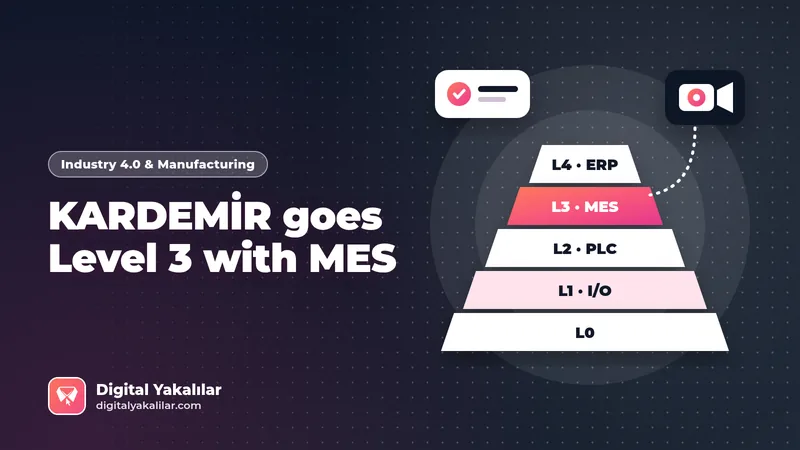
Large Turkish manufacturers are thickening the ISA-95 Level 3 MES layer between ERP and shop-floor automation — see KARDEMİR's Level 3 MES programme across 27 sites. APEM closes the energy and sustainability slice of the same digital spine: without production context, "expected consumption" models are weak; without energy data, MES OEE misses cost and carbon reality.
SMEs mapping a roadmap can use our TÜBİTAK DDX digital maturity guide. For warehouse agents, see AI agents in the supply chain.
Maturity ladder for factory energy AI
| Level | What you do | Typical output |
|---|---|---|
| 1. Digitize meters | Monthly bills / manual reads | Lagging report |
| 2. Real-time monitoring | SCADA / IoT dashboard | Alarms without linked action |
| 3. Deviation + work order (APEM-style) | Model + maintenance integration [1] | Automatic field task |
| 4. Joint production–energy optimization | MES + energy + planning | Shift/plan decisions include energy |
Ford Otosan's example sits at level 3: monitoring and action share one structure [1].
Checklist: AI energy management in manufacturing
- Are critical electricity, gas, water and compressed-air points mapped?
- Does the expected-consumption model include product, shift and ambient conditions?
- Do deviation alerts become work orders, or only emails?
- Is there CMMS / smart-maintenance integration?
- Are CO₂ and kWh targets written with baseline year and Scope 1–2 boundaries?
- Is the model retrained to cut false positives?
- Is data ownership clear among energy, production and IT?
Frequently asked questions
What is AI energy management in manufacturing?
An AI layer that combines consumption data with production context, detects deviations and steers maintenance/energy teams to act. In Ford Otosan's APEM case that means 1,000+ metering points and automatic work orders [1].
Is APEM a packaged product?
The company describes it as an industrial AI layer built for its plant needs, not a single off-the-shelf SKU [1].
What about the 2,560 t CO₂ and 19.66 kWh figures?
They are targets/results stated in the company announcement [1]. An independent third-party audit is not included in that article.
Can a smaller plant copy this?
Yes at smaller scale: digitize 20–50 critical points first, then close the deviation→work-order loop.
Does this post cover e-commerce or consumer gadgets?
No. It is about energy management and industrial AI in a production plant.
References
- Ekonomigazetesi, "'MEGA AI APEM ile enerji kayıplarını henüz oluşmadan tespit ederek önlem alabiliyoruz'" (Ford Otosan statement), updated October 8, 2026. https://www.ekonomigazetesi.com/sirket-haberleri/ford-otosan-kocaeli-fabrikalarinda-enerji-yonetimini-yapay-zekayla-donusturuyor-89288 (Accessed: October 16, 2026)